Vineeto: The way “naiveté come[s] into picture” is that with sincerity and naiveté you apply no moral or ethical or ‘actualistic’ judgements as to what feeling is occurring and therefore can apply unrestricted attentiveness – (…) (Vineeto to Srid, 5.1.2005)
Srid:|
- A few hours after having emailed her, I began despairing ‘She would not respond at all’ (rejection).
- This lead me to consider the likely possibility of going about it on my own.
- Which had me wonder about the actual meaning of Vineeto’s word “closeness” in that post linked above
- Then, I checked out my honest motivations behind wanting to getting back with her
When I wrote to Vineeto “enjoying what already unfolds in this very moment, without any regard for (immediate or distant) future”, what I had in mind however was a plan (ha!) to ‘bottle up’ my affections for her boxed up in ‘this moment’ (which, unlike the actual moment, is sandwiched between the ‘past’ and the ‘future’) whilst not letting it “escape” into a ‘future’ via hopes & dreams.
This is how I interpreted Vineeto’s word ‘closeness’ (as the ‘bottling up’), which is obviously different from how Vineeto and other actually free people use it.
- Finally, I wondered what this actual ‘closeness’ would be like with her (if I were to get back), concomitant to wondering how it will be for Vineeto if she were to interact with a man. It hit me right there: there would be no affections at all (I felt a tiny sense of sadness at loss, here). How can that be! Seems like a freaking huge sacrifice! It would instead be a … umm … sensate closeness. In other words, an immediacy with her. Physical and sensate immediacy. No affectionate experiencing.
Hi Srid,
To answer your question regarding “the actual meaning of Vineeto’s word “closeness”” – it is the same meaning as in Richard’s description of Grace’s scale, which has been recently mentioned by you and others several times –
Richard: A closeness is where the personal boundaries are expanded to include the other into one’s own space; this is a normal type of intimacy. (Richard, Abditorium, Intimacy, #Intimacy)
By putting your own interpretation on it (perhaps because you regard yourself not like “normal” people) makes communication rather difficult and is, of course, misleading yourself. Here is where I perceived that you may regard yourself not like “normal” people –
Srid: I recognize this to be a common ‘cycle’ I tend to go through – swinging between two extremes (hope & despair) much more than a normal person would. (inserted comment to point 1. in Srid’s PCE log 7)
Srid: Once I stayed with despair, I was able to pinpoint the exact beliefs involved. I located two of them: a) woman is attracted to man => woman ‘values’ man => man feels ‘valued’. This intuited ‘value’ was the source of my ‘self-worth’ (incidentally, this is a common experience for normal men too). [Emphases added]. (Srid’s PCE Log 5, inserted comment)
I only mention this because if you to consider yourself better or worse than “normal people” (btw, from what I observed, most people class themselves on a hierarchy scale) – the fact remains that you are endowed with the same instinctual passions as everyone else. To feel yourself other than “normal people” only creates/ maintains yet another layer of a superior/ inferior identity.
Just out of curiosity, do you know how a “normal” person would be “swinging between two extremes” so as to be able to say you are doing it “much more”?
You said in another inserted comment –
Srid: While I can’t speak for others, I consider words like ‘intimacy’ to be counterproductive to me as I tend to immediately (no pun intended) associate affectionate factors with it. (third insert in Srid’s PCE Log 7)
Just to clarify, the word intimacy means affective/ affectionate intimacy unless otherwise specified. Below Richard goes into great detail what the word ‘intimacy’ means – no different to the normal dictionary meaning –
Richard: Therefore, what you are effectively asking – via your “is ‘real intimacy’ the same as ‘the affective intimacy of love’ mentioned below?” wording – is whether or not intimacy, for feeling-beings, is the same as the intimacy of love.
Yet, because intimacy can be referred in several ways (i.e., via its denotation, its connotations, and its consuetude) by feeling-beings – as indicated by those quick dictionary definitions you provided – then your query makes about as much sense as its obverse would (i.e., whether or not the intimacy of love is the same as intimacy).
As the word ‘intimacy’ refers to the state or condition of being intimate – a word which comes from Latin intimātus, ‘to make familiar with’, past participle of intimāre, intimāt-, ‘to make known’, from Latin intimus, ‘innermost’, ‘deepest’; from intus, ‘within’ – perhaps some more extensive dictionary entries than those quick ones will throw some light upon what it is you are wanting to know about intimacy per se and the intimacy of love. Viz: (extensive dictionary definitions and more details in Richard, List D, No. 46, 7 Feb 2016).
Hence there is no need to create your own vocabulary. It only interferes with clarity in communication. When Richard is referring to non-affective intimacy, he specifies it as actual intimacy.
There is more information both on affective intimacy as well as actual intimacy in Richard’s Selected Correspondence.
Srid: PCE (sensate reality)
When this started happening, I was actually playing a game on my laptop (semi-focused; because points 3-5 were percolating in the background of the mind) seated on the couch in my dimly lit living room. I remarked to myself, “Whoa, this looks like it is in 4k [resolution]” … referring to the indubitably immediate visual perception of the entire living room being experienced in “higher resolution”. Crisp, and everything’s here, with no ‘outside’ to it, and self-sufficient … thus automatically obviating the despair of ‘going about it on my own’ or the fear of ‘facing rejection’ or the hope of a permanently percolating aura of affections.
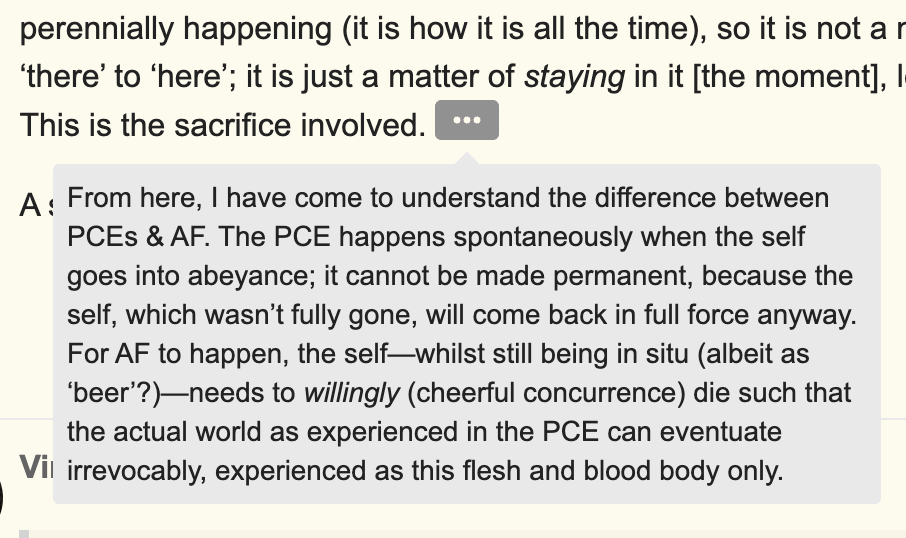
The answer to my wondering in (5) became experientially answered in this mini-PCE, and it blew my mind. No affections, really? “Just” a sensate immediacy—and, the same immediacy with the objects in my room, albeit with the difference being the other is a living and conscious fellow human (a female one at that)? In the PCE, it became so obvious to me that this moment is perennially happening (it is how it is all the time), so it is not a matter of ‘boxing’ myself in it from ‘there’ to ‘here’; it is just a matter of staying in it, leaving “me” behind in the process. This is the sacrifice involved.
A strong golden clew has been established. (link)
This short experience appears to have more the elements of a genuine PCE than the one you described before. You headed the last experience as “EE (center-less)” and said “even though I couldn’t tell if it was PCE” (link) but then proceeded to call it a PCE in your most recent reply to me, “(this was a few days before the PCE on post #5)” (link). It is indeed vital to have a clear, clean memory of a definite experience of a PCE to establish “a strong golden clew”.
Your follow-up ruminations, which obviously happened after the PCE had ended, thinking “it is just a matter of staying in it, leaving “me” behind in the process” need some clarifications.
Richard: I will take this opportunity to add that an as-fully-informed-as-possible identity is vital to the whole process as only an identity, and no-one else, can set its host free. For instance:
• [Richard]: ‘… you have a vital role to play, not only in regards peace-on-earth, in this lifetime as that flesh and blood body, but in enabling the already always existing meaning of life (or ‘the purpose of the universe’ or ‘the reason for existence’ or however one’s quest may be described) into becoming apparent.
In short: your freedom, or lack thereof, is in your hands and your hands alone’. (Richard, AF List, No. 80, 28 Dec 2004).
Another way of putting it is that identity has a job to do. Viz.:
• [Gary]: ‘Is it correct to say that ‘I’ am in abeyance during the PCE?
• [Richard]: ‘That was the word that occurred to me to describe the experience … ‘suspended’, maybe (as in ‘the operation has been suspended until further notice’)?
• [Gary]: ‘Or is it more accurate to say that ‘I’ have vacated the scene completely and totally?
• [Richard]: ‘Oh, yes, there is a marked absence of ‘me’ during the experience … perhaps it is more correct to say that it is after the experience, when ‘I’ reappear, that in hindsight it becomes obvious that ‘I’ was in abeyance?
• [Gary]: ‘What causes ‘me’ to return?
• [Richard]: ‘Because ‘I’ have a job to do: ‘I’ am going to make the most noble sacrifice that ‘I’ can make for this body and that body and every body … for ‘I’ am what ‘I’ hold most dear. It is ‘my’ moment of glory. It is ‘my’ crowning achievement … it makes ‘my’ petty life all worth while. It is not an event to be missed … to physically die without having experienced what it is like to become dead is such a waste of a life’. (Richard, AF List, Gary, 15 Aug 2000).
(Richard, AF List, No. 74e, 28 Dec 2005).
In short, there is no way to proceed from a PCE into an actual freedom because the very process of “leaving “me” behind” requires ‘my’ action and ultimately ‘my’ full acquiescence, which cannot happen whilst ‘I’ am in abeyance or suspense.
Again, it is worthwhile noticing the many and various cunning tricks ‘I’ employ to stay in existence. It is quite amusing once you discover them.
Cheers Vineeto