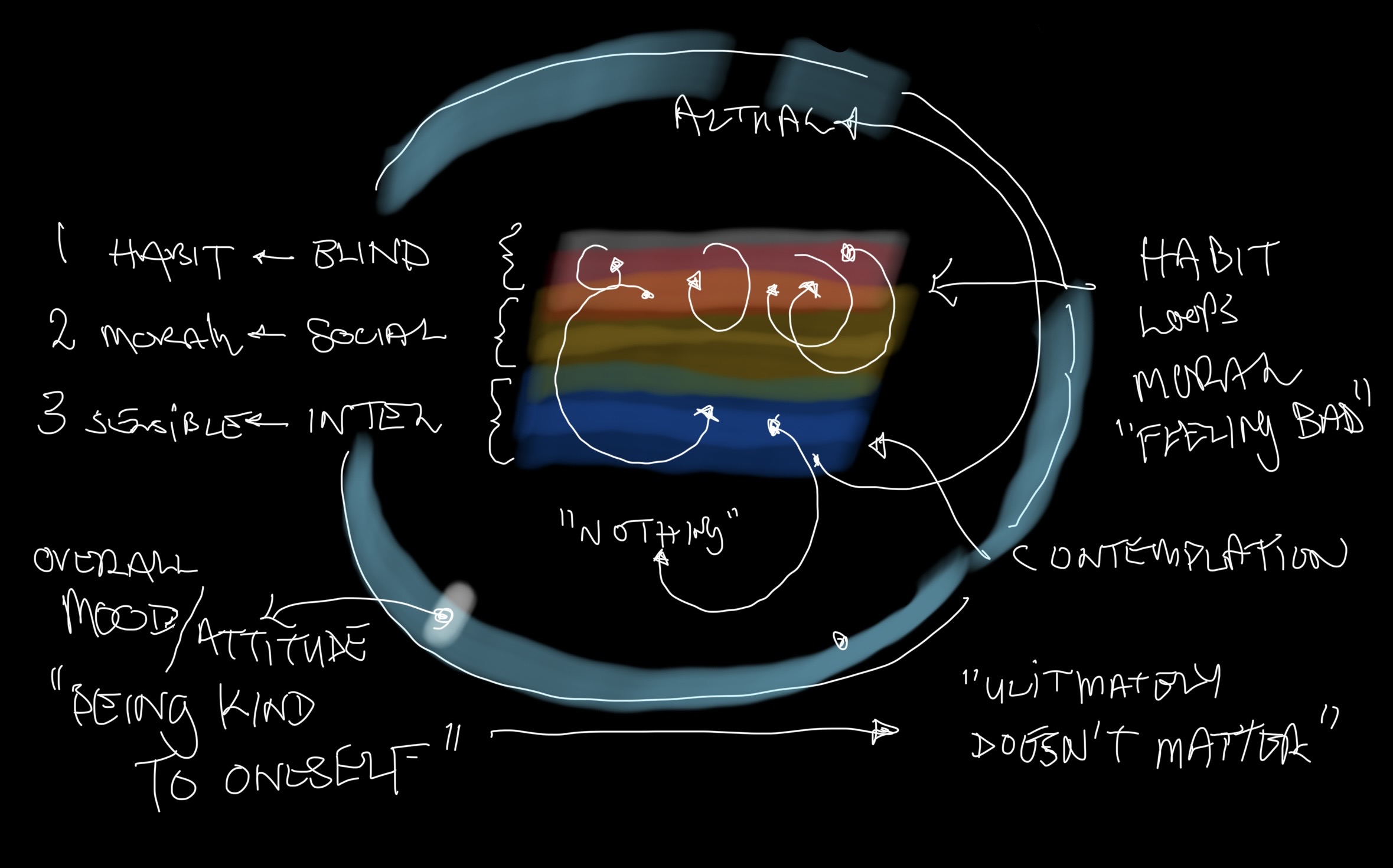
Vineeto: “That is great – and that is also one aspect of what you later mentioned as “cut to the chase”. Now you know how to share without having to ‘cringe’ afterwards. Find out what happens when you acknowledge, that loneliness is merely a feeling and there is no obligation to fulfill this feeling’s demands.”
Andrew: This last sentence of yours has been a theme for me for a while “no obligation to fulfill this feeling’s demands”.
Hi Andrew,
It is indeed a good theme to keep at the front of your mind and helps to shift from urges to preferences upon sensible contemplation on dominant feelings.
Andrew: I am seeing now that because I have ignored many subtle feelings, and generally been focused on the demands of the “big ones” (fear, sadness, anger), the details of the genuine feeling happening, which can make a difference, have been glossed over.
For example, I saw today in addition to loneliness, I was blocking out any desire for physical touch. It’s now over two years of celibacy, and I had thought that with the reduction of libido, and whatever other factors, desire and affection were not going to feature much more.
But! I was ignoring all the dreams of women I have when asleep. Or not so much ignoring them, but not considering their importance. I have had plenty of girlfriends in my sleep! Haha
This also had a parallel today when walking. I should be enjoying myself based on the circumstances. There were moments, and there was a moment or two of naïveté, well, the curiosity that is a childhood “friend” to naïveté.
Ah, once you get into the habit of not instantly fulfilling the dominant feeling’s demands you become aware of the more subtle feelings which “have been glossed over”. Can you see that this increased sensitivity and its accompanying information about how you ‘tick’ helps you to shift to more enjoyment and appreciation?
Andrew: The should was obvious. I was trying to force myself to “enjoy”. I started to notice that I “lump” emotional “feeling good” in with conditional enjoyment. As in, a nice soft lounge is preferred to a grass lawn, and a grass lawn preferred to a patch of dirt. As I looked around, I wanted a soft couch!
I started to see that separating out my preferences from my emotions is an aspect of what ‘feeling good’ is all about. The “come what may”.
It’s not that the river isn’t pleasant, but I emotionally tire of it as I prefer to be at home in my comfy chair! Noticing when a preference is being ignored, or otherwise the feeling being ignored one two things for me to work on; one being as sincere as possible about my feelings in as much subtle detail as I can, and two letting preferences be separate to the goal of feeling good.
However, I lost the theme I was wanting to talk about concerning “…merely a feeling and there is no obligation to fulfill this feelings demands”.
Excellent, the more attention you pay to how you affectively experience this moment the more you have the choice to nudge it towards feeling good.
Andrew: I think it’s worth posting rather than not posting. Even though there is, and will be, feelings and demands, I can see that having sincerity can bring everything back on track, even if the initial inspiration was misguided but well intended. (Empowering myself to post, even though I already post a lot. Haha) (link)
I agree with you – writing it down often helps to stay on track in one’s thinking and to come back to the original question/ theme after branching out into various explorations –
Q(1): I have a lot of trouble with thinking – with my thoughts – and what is the work in it, or the effort in it, is that they always have tracks that want to be followed and they are hard to catch … to catch me …
R: Going off on a stray thought?
Q(1): They are keeping me so busy … that I …
R: Yes, but you can actually have fun with this. Have you ever followed a thought right through to its very end?
Q(1): I’m not very good at that.
R: Would you like to? It is fun! You start off with an original thought – you may be silent for a while and a thought pops into your head – and you take particular notice of what that thought is. Put a mental circle around it, or some stars or something, to lock that original thought securely. Then just let your thought wander … you wander with your thoughts … following them through to wherever they go. You will go off into a side branch … and that will branch off into another side branch … and into another and another … and so on. Then you are completely lost. This is the normal way of thinking.
Q(1): Yes, right.
R: Your thoughts meander. Learn to catch yourself meandering; let the meandering go on and after a period of time – three or four minutes – take note. Think to yourself: ‘Wow, where am I at? Where did I start in all this?’ Then you come back to that original thought that you marked and locked in securely. You start with that thought again. Once more, let your thought proceed … this time you will meander off in another direction … and off along another branch … and another … and so on. Once again catch yourself after a while; you may say: ‘Oh, that is interesting, I went off into a side-track there!’ Come back to your original thought that you put a circle around and you will find that it has progressed a little – before you started to meander for the second time you proceeded a short way. So you put a ring around that and – it is so lovely to do this – and then eventually you will be able to follow a thought right through to its very end. And when you do get to the end, some magic can happen. It is so wonderful to do this! You can spend an hour or two doing this; following a thought, meandering, coming back, wandering again, coming back … and so forth.
We can do this in a talk, a discussion. We start this particular conversation that we are having now, and what I do is I mentally note how it started. Everybody can have an input and we can talk and talk and explore and discover – we meander. After a while you will find me saying something like: ‘To get back to what we were talking about at the beginning …’ and that brings everybody back to the original topic. Then off we go again, to wander and ramble again – and I take note of where we progressed to before we digressed for the second time …
Q(1): But the interesting part is that I … not the meandering, but the earlier I catch the meandering and go back to the original … but … oh, I see; the important thing is that I follow the trunk.
R: Right to the very end. It is a lovely thing to do – it is delicious – because you get to know the workings of your own mind. This is your brain in action. (Richard, Audio-taped Dialogues, Silly or Sensible)
Andrew: Additionally, as a placeholder for this thought: ignoring the first impulse in any behavior/ decision, and going for a second thought, or as best to a sensible one as possible. The idea being, the first impulse is going to be the unintelligent feeling more than the second or third which will be more conditioned feelings, and progressively have less distance between sensible thoughts and behaviors.
The idea being, feelings arrive faster than a “thought through decision”, so as a blanket rule, ignoring the first impulse is going to catch the majority of blind reactiveness.
the rest of the time, leaning into sensuousness, and general “external” awareness of what is actually going on, and the opportunity that “change only happens now”. (link)
This is an excellent discovery and worth sticking on your fridge, so to speak. I like it.
Feelings are indeed both faster and more dominant compared to rational, sensible thoughts in the information chain of the brain (link).
Cheers Vineeto