I took a break because I decided to post here infrequently, with enough time between sessions to make participating more useful than otherwise.
I have a stable sexual partner.
I almost fell in love once again, but caught it early!
My obsession with attraction and romance was largely because I believed it was the only (acceptable) path to sexual pleasure.
Talking with people, I’ve learned two things: attraction often fades, sometimes within two months; and women can stay with a man (as husband or partner) without being attracted to him. These helped diffuse my desire around the whole attraction/romance business.
Sex is just what it is, mutual bodily pleasure happening now, rather than something projected onto a future (as with romance and attraction).
The investigation is still going, but I’m pleased these patterns are starting to weaken significantly. Minor triggers and fears still pop up, but the mechanism is largely understood, so it comes down to noticing and declining the habitual path. Honesty with myself and the women from the get go (contrary to societal conditioning) is the key.
I’ve also learned that I prefer a FWB arrangement to anything else. My hobbies have not changed. I’m not sure where I picked up the idea that relationships, love, “soulmate”, “life partner” and the like are meaningful or important. Growing up I never believed in marriage or raising kids; that came naturally, no doubt largely due to my neurodivergence. But the sexual instinct somehow got channeled into modern dating and romance lore. I wish this part of the social identity had been more openly questioned in the prior forums some of us participated.
Happy to answer any specific questions. I’ll give it a couple of months or so before I have something new to report. In the meanwhile, all feedback welcome.
I realized my last post skipped over the specifics of what helped me get here. Capturing it here for posterity. In particular:
Sincere awareness (I wrote about this here when last participating).
Repeatedly going down the planning route, with each eventual recognition reducing its prevalence and duration.
Eventually appreciating the sensibility of just doing the actualism method on a moment-to-moment basis (especially getting back to feeling good, or live exploration when things aren’t too bad).
Above all, a neurodivergent-flavored passionate energy (hard to fully articulate; it is the same thing that drives hacker culture).
From that first-principles approach (bottom-up investigation via the moment-to-moment actualism method), the things mentioned in my previous post naturally followed over a period of time.
Things are moving rather fast for me that I wanted to quickly report before forgetting the details as I did in my last posts.
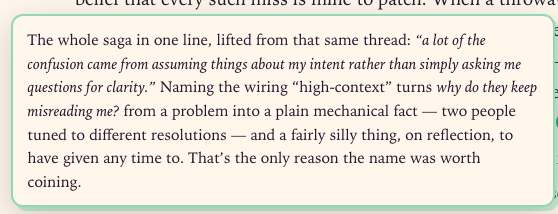
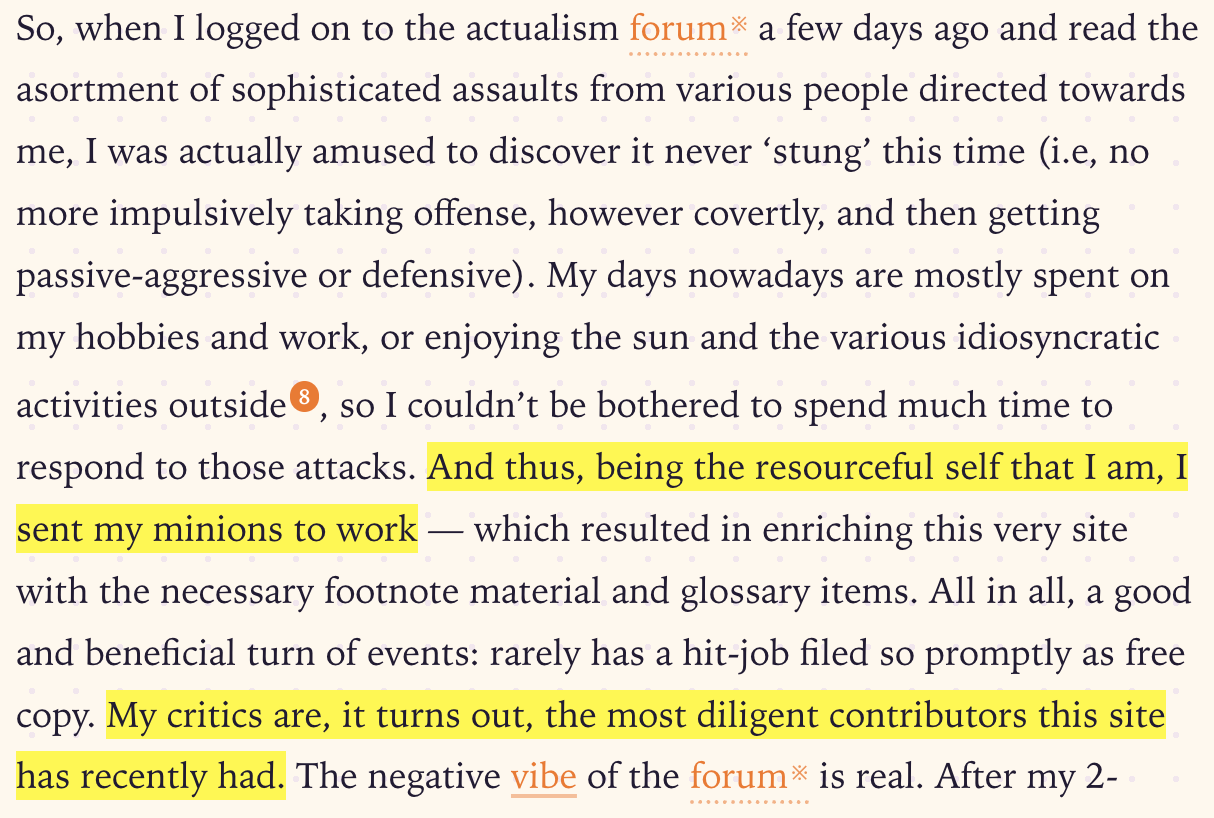
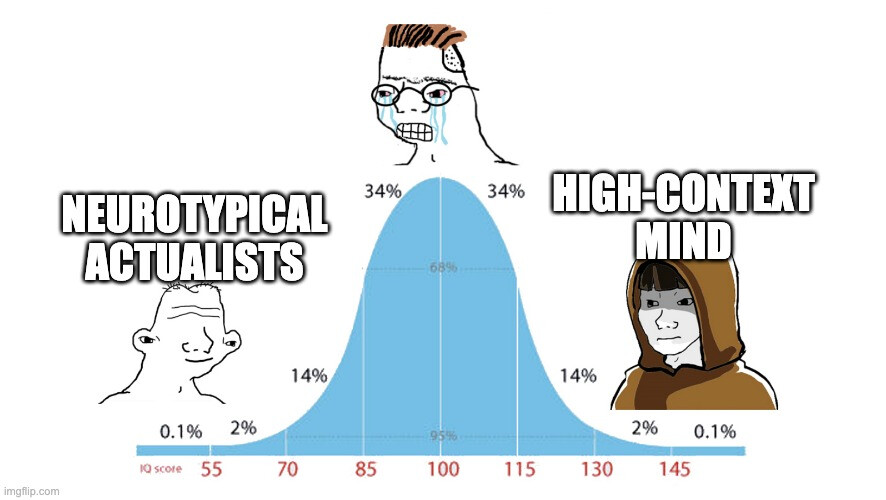
It is amazing how fast I can learn and adapt—be it actualism or anything—as long as I just embrace what I can my ‘high-context’ mind (I don’t mean ‘high-context’ culture here). So, it turns out I can hold a lot of different things at the same time. Like a lot. The downside is that it is difficult to communicate at the same velocity and scope, especially with neurotypicals. Language can only express so much. So it makes sense why I decided to discard the actualism ‘framework’ back in January and start from raw sincere awareness. I don’t read AFT anymore ‘out of habit’, but I do read it from time to time. I don’t practice the ‘actualism method’—and by that I mean, I don’t go “Okay, here are the steps; let me follow them one by one”. The framework doesn’t even exist even in this large high-context mind. But! It does come, in parts, in hindsight. Two things I found relevant time and time again: getting back to feeling good & investigating within ~30 mins. Actually, there’s a nuance to the first one (real-time is possible as long as __), but I’ll leave it for sake of brevity and also because I find writing more a chore nowadays.
I had also discarded the feeling nomenclature Richard came up with. So, the combination of this high-context mind + sincere awareness has been most fun and effective to tease out (in real-time, if not during that ~30 mins timeframe) what’s going in the psyche. I had also dropped feeling names & categories, and just went for raw experience.
I was under the erroneous impression that the many feelings a man has towards women revolve around sex, but this is not true. Sex is a pleasurable act of its own. By now, I’ve fully figured out how the whole psychic apparatus around sexuality works. The closest to what Richard describes here is ‘desire’ and ‘nurture’ (see my last post). Libido, btw, is just one aspect to ‘desire’, AFAIU. I’ve never set out to ‘nip libido in the bud’ (for instance); in fact, ‘nipping in the bud’ is something I never do. Instead, it is is more like pulling your off-track car back on highway. Not sure if I described it quite well; essentially what I always “did” (or “do”) was to get back to the actual moment as it happens (now), away from the inner feeling world (and the psychic timeline), if that makes sense. With women, I would readily find out if there’s mutual attraction, rather than imagining or hoping or intuiting for an outcome or stance. I discovered that, this way, I am spontaneously flirtatious even if I didn’t intend or want to (LOL). No games or facades. No holding back. That’s what ‘desire’ segues into, naturally — in the backdrop of the stable intent to be happy & harmless (to use Richard’s lingo) under the hood — so I just let it be. That stuff is fun … until it isn’t. This where ‘nurture’ comes into picture. I thought I had put those feelings to rest, but they kept popping up in different forms. Using sincere awareness (and without relying on Richard’s words), I teased out everything that was unfolding in the psyche …”all feelings as commensurate” (good/bad; covert/over) as Richard wrote in ASA article. But—and this is important—it did not happen in void; that teasing out only happened in the comparative context of wanting to be here … wanting for anything to happen now, rather than future. That’s what made it easier to give up on seductive feelings like hope or beauty, for instance. And it is so obviously true that, to not be emotionally dependent on the other person (such as for them to be able to manipulate you for instance) is salubrious for all the parties involved. In fact, I’ve found that the moment I ‘need’ her, she starts to lose interest. As for sex, even though I enjoy having sex with my partners, I don’t ‘look forward’ to it like I used to. I quite enjoy my own company, and there are so many other interesting things to do in life.
I can now see that ‘enjoy & appreciate’ makes sense. ‘Enjoy’ is something I would never use normally but that’s the word that would describe my experience. Appreciation is an interesting one, because it doesn’t operate consistently enough yet, but whenever it does it just magnifies everything. The other thing I’ll mention is that since January, I dropped both AF and PCEs as a ‘goal’. Basically I stopped caring about them. But I do now know that PCEs can more spontaneously happen going forward with less ‘self’-centric stuff going on. Whatever happens, it’ll be good - because it doesn’t matter in the end as the entire solar system will die out anyway LOL (seriously though: this perspective has always remained a critical element behind my practice).
I had a look at the website (it’s got very pleasing visuals actually!) and your entry. I noticed you used the word neurodivergent several times in the article, in fact neurodivergence seems to be the main thread running through the writing.
I wonder though (and have for a while) about this whole neurodivergence thing, specifically where it relates to facticity and actualism. It seems to me that just like a few years ago everybody and their dog were busy switching between the endless array of gender personas, now something similar is happening with neurodivergence, basically it seems to be a bit of a fad!
My Instagram/Facebook feed is full of content about Autism this or ADHD that, and then there is the AuDHD which is a mix of both so you can have it all . It is clear that people have turned these labels into personas, it seems like an attempt to alleviate the weirdness and rottenness of the human condition by applying a neat and convenient psychiatric label to its inevitable manifestations. Besides just what is the ‘normal’ which the ‘neurodivergence’ is diverging from?
And really isn’t this all the same as say horoscopes? That ‘I’ get to fit into some pre-ordained archetype and then ‘my’ rottenness all of a sudden ‘makes so much sense’. I do strongly question the facticity of all this.
Also (and this is a pertinent point for any actualist) aren’t these labels adopted specifically so that one never has to change? ie “you cannot change human nature”. It’s telling to consider the fact that no ‘neurodivergence’ will survive into actual freedom, it will disappear along with ‘me’.
Fair warning, Kuba, I write high-context: I know what I mean, and I’m quite content if it doesn’t fully carry to every reader . The fad’s daft and fair game, granted, the self having exhausted the zodiac and graduated to the DSM, ‘my’ rottenness “solved” the moment it’s issued a four-letter acronym. Grade-A psittacism (psittacus, n., parrot). But you’re up the wrong tree on me: there’s plenty of ‘self’ still rattling about in here, “neurodivergence” just isn’t one of its costumes, only the handiest name for how my predilections run on their own. And here’s the giggle: your own Vineeto already granted me the factual bit. She tells you, in your own journal (#1658), that it’s “not autism in the medical definition of the word, but perhaps a tendency to be less interested in how people you are not personally connected to are experiencing life,” and that “it can vary from person to person”. That per-person tendency is all I’m naming, just pointed the other way. So take the facticity complaint upstairs, mate, and give Vineeto my regards .
Syd: Fair warning, Kuba, I write high-context[1]: I know what I mean, and I’m quite content if it doesn’t fully carry to every reader. The fad’s daft and fair game, granted, the self having exhausted the zodiac and graduated to the DSM, ‘my’ rottenness “solved” the moment it’s issued a four-letter acronym. Grade-A psittacism (psittacus, n., parrot). But you’re up the wrong tree on me: there’s plenty of ‘self’ still rattling about in here, “neurodivergence” just isn’t one of its costumes, only the handiest name for how my predilections run on their own. And here’s the giggle: your own Vineeto already granted me the factual bit. She tells you, in your own journal (#1658), that it’s “not autism in the medical definition of the word, but perhaps a tendency to be less interested in how people you are not personally connected to are experiencing life,” and that “it can vary from person to person”. That per-person tendency is all I’m naming, just pointed the other way. So take the facticity complaint upstairs, mate, and give Vineeto my regards
[1] A mind that holds many disparate things at once and learns and adapts quickly — at the cost of being hard to communicate with at the same velocity and scope, especially for neurotypicals. (link)
You have stated that you “never set about to do that [channel the instinctual passions into being the felicitous & innocuous feelings” because the obvious common sense of doing that eludes your supposedly “high-context” mind-frame, (even though it allegedly “holds many disparate things at once”). You also declared that your “high-context neurodivergent frame” can only perceive to “channel the instinctual passions into being the felicitous & innocuous feelings” “in moralistic-forcing way” (link) and that you have given up on the goal of “both AF and PCEs” (link) – in other words, you cannot change your nature and therefore there is really nothing worthwhile discussing here. Kuba has already pointed out (link) that such neurodivergence labels are easily turned into personas and your previous and present responses have just demonstrated and confirmed this.
It has already been extensively explained in what way the intent to be happy and harmless, felicitous and innocuous can be arrived at without any moralistic forcing, both by myself (for instance: link), and even more detailed by Claudiu (for instance: link) but the common sense of becoming happy and harmless has so far eluded you.
This forum has been specifically set up for those interested in changing their human nature and becoming happy and harmless, felicitous and innocuous, whereas your way of non-“moralistic-forcing” communication is clearly not even intended to be friendly and innocuous, or even civil, but aggressive, derogatory, condescending and supercilious, reminiscent of your communication style in December 2015 on Gitter –
[Syd]: ‘…we should start ‘giving shit’ to these rude people, regardless of their sex’. (Dec 07 07:31).
[Syd]: ‘…if the other person is ‘giving me shit’, expect to the receive the same back (at same level of subtlety)’. (Dec 07 07:44).
[Syd]: ‘Indeed, that’s what I’m getting at. If they give me shit, I give them back’. (Dec 07 07:49).
It looks like Richard’s recommendation from 10+ years ago is still applicable.
Richard: It appears that it has not occurred to you how this aggressive attitude/ approach of yours – your tit-for-tat modus vivendi – is in lieu of dissolving those childhood hurts you stubbornly nurse in your adult bosom.
(…)
In other words, with the dissolution of those childhood hurts the (deeply felt) need for your aggressive tit-for-tat modus vivendi will also vanish … leaving you free to treat …um… the ‘other’ as a fellow human being (rather than as an adversary to gain dominion over). (link)
Your present post demonstrates that you are still seeing the world through the prism of the power structure of hierarchy, superiority/ inferiority, pride and humility, while imagining yourself as No. 1. This unexamined emotional hierarchical template/ framework is both the underlying foundation for your concept of what “moralistic-forcing” means and the justification for your own rebellious behaviour, and it goes a long way to explain why you cannot see the quite obvious common sense in having a sincere intent to become happy and harmless, which are two sides of the same coin (see link). It also explains the creation of an imaginary phantom ‘Vineeto’ who is allegedly Kuba’s “own Vineeto”, situated “upstairs”, which is so far out inside your high-context mind as to be ludicrous.
Here is a quote of the day to ponder –
Richard: … the term ‘cognitive dissonance’ would be better described as a ‘feeling-fed cognitive dissonance’ as it is not just a mental blockage which causes people to be unable to grasp innovative things that are to their own advantage and to fight so hard to retain the existing belief systems which are inimical to their welfare.
It is the strangest of incongruities in regards to human pertinacity that peoples will invent reasons and struggle to maintain a state of affairs that is detrimental to their own advancement … even those conditions which enslave them. (Richard, AF List, No. 30, 22 Oct 2003).
I noticed you updated the high-context page with the following footnote:
SYD: The specimen, for the curious. On the actualism forum I’d said happiness and harmlessness are inseparable and cannot be sequenced . A senior member corrected me — informing me I was “nevertheless establishing a sequence of happiness first, then harmlessness second” — and a second hailed the correction as a “brilliant exposition,” “patiently and expertly made clear.” Between them they had handed me back my own thesis wearing a rosette, both certain they were setting me straight on a point I’d just made myself, all because “before” was read on its wristwatch setting rather than the one I meant. (the correction; me unpicking it.)
Setting aside the grating tone of the AI-assisted writing, this is not the factually correct sequence of events – and the fact that you got the history wrong and that you further still don’t seem to understand what Vineeto and I were or why we were saying it, does not speak highly of the allegedly amazing alacrity[1], boundless bandwidth[2], and superior specialness[3][4], of this so-called[5]“high-context mind”.
The lynchpin is “all because “before” was read on its wristwatch setting rather than the one I meant”. By this you are presumably referring to your February 19 post[6] where you wrote:
However, the “correction” post was not even replying to this post of yours. It was replying to a different post, namely, this one (split among two posts):
The response I made was:
Note well that there is no possible way this post could have been in response to any post containing the word “before”, as there is no post by you whatsoever on that thread which contains that word “before”.
Now, I know well why I wrote what I wrote, and I’ll expand on it below. But first, a brief diversion into the rest of your footnote, which continues:
SYD: That’s the part about desire , not merely difficulty: when a misreading is that eager — when the small courtesy of asking what someone means never crosses a single mind — there is nothing left to fix by explaining harder, and I find I can’t be bothered to try.
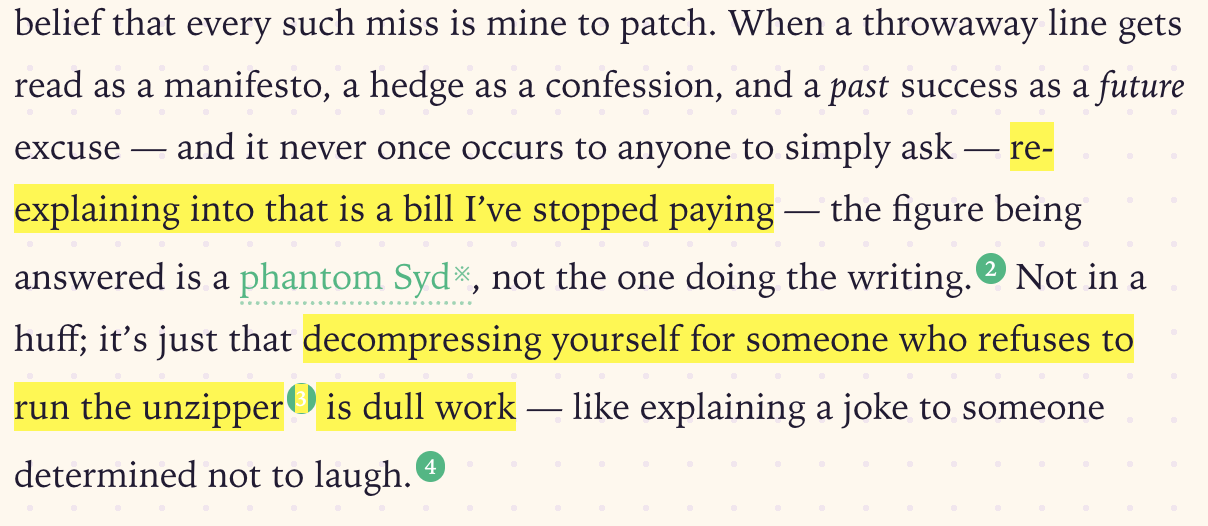
This appears better directed at the person who wrote it than anyone else. You didn’t stop to ask either me or Vineeto why we wrote what we wrote. You merely assumed we forgot about what you said or never carefully read your post in the first place or that we didn’t really understand it. You then ehh rather eagerly took that assumption as definitive conclusion, used it to castigate me and Vineeto, and all this has now spawned yet another term (“high-context mind”), which apparently (from the current definition page) was created specifically to refer to the alleged inability of your correspondents to understand what you are writing (because your mind “holds a dozen things at once” and “ships them in a single breath”, “One sentence carrying ten”, where the correspondent can only “catch two” [i.e. one-fifth of what was said], due to the author’s “neurodivergen[ce]”… and you’ve “retired […] the belief” of having to “patch” misunderstandings because it is “dull work” [source]).
However, as none of these assumptions are warranted given the text of the replies, and it’s more that you misunderstood what we wrote and why we wrote it, it makes the allegedly advantageous acuity of this ”high-context mind” somewhat suspect, and rather deflates the entire premise of the term, and, apparently, of the (now “high-context”) journal itself[7].
The most egregious misunderstanding, which really ought to have prompted a follow-up question[8] rather than a conclusion that we know not of what we speak and we eagerly seek to misunderstand, is your conclusion that both Vineeto and I missed the fact that you yourself already wrote that happiness and harmlessness are "inseparable and cannot be sequenced". However, this is plainly false – the quoted response post above directly addresses that “even though you say that happiness and harmlessness are two different elements of the same thing,” and even literally quotes you saying they are “two different aspects of the same thing”.
Vineeto’s response as well contained a direct reference to what you said, even bolding the key terms and writing how pleased she is that you got it:
Your response to all this was:
This response is mind-boggling because both of us clearly read what you wrote and were directly addressing it.
Now, the reason I wrote the “correction” post I did (I can’t speak to Vineeto’s reasons, though I do presume they are quite similar), is because of the way you were talking about happiness and harmlessness and the relation between the two. You wrote, with regards to being angry at your father and this leading you to find harmlessness as a motivating factor, that:
Note the way you talk about it here: you write as if there is already an “existing motivating factor of happiness”, and then you find this “harmlessness” to be a factor on top of that.
This is not someone maliciously misreading a single word “before” and misinterpreting it – it’s literally how you actually presented it (and we can only go by what you write).
(Also, in the normal course of conversation, someone says something, the other responds to it, and if there’s a misunderstanding, then it’s an opportunity for the first to clarify – rather than walk away “[n]ot in a huff” [source] and give up.)
Further you wrote:
Again here you talk about a position of “having already established happiness as no. 1 priority”, and that without that… harmlessness seems like morality!
The phrase “having already” clearly denotes something already done. You write it very plainly here that only with happiness first/firstly established/already established, does it make sense for you to consider harmlessness – hence a type of “sequence”. Not necessarily chronological, but a certainly a priority ordering.
This is why I wrote the rest of my response as I did, pointing out that harmlessness can be the entry point into the self-reinforcing happy and harmless duo as well as happiness.
Your response may, yet again be, to protest, that you did write that happiness and harmlessness are inseparable, not able to be sequenced, etc., and that you know all that and you are not sequencing them. Yes, you did write that. Both Vineeto and I acknowledged that, each time repeatedly.
The overarching point is that actualism is not about stringing together the right sequence of words and then getting a cookie when you’re able to properly repeat the sequence. Actualism is about gaining the experiential insight into these matters, and having it genuinely change one’s way of being. The best way one can help someone do this is by reading the entirety of what you write, then making an assessment as to what is really going on, and then speaking in an attempt to address that.
In this case, based on the quotes above, the other stuff you said about happiness and harmlessness indicated a still-lingering promotion of happiness over the other.
If you had said, instead, for example that harmlessness doesn’t work (seems like moralizing) unless you’re happy, but also happiness doesn’t work unless you’re already harmless – this would have been a different matter. Note that even if you had perfectly said all that, it still wouldn’t mean you necessarily got it, and it would be a matter of seeing what else comes up too.
Now it’s entirely possible we were mistaken and though there was a prioritizing of happiness without harmlessness in the past, there isn’t one today – sure. That would be a topic of further conversation, not, eh… all this.
Now, in terms of a highly adept mind holding many things at once, compressing information density at high velocity – consider that all ~2,200 words that I wrote above, I essentially grasped all-in-a-moment from the first time I read that 93-word paragraph in your “me unpicking it” post[9] (with relevant further parts similarly readily apprehended when reading along the following posts).
Further, essentially every paragraph you write, often once per sentence and sometimes even multiple times per sentence, I come across some such a misapprehension, misconception, misunderstanding, a very clear and glaring going-awry, which is similarly grasped all-at-once. The impression given is one of fractal wrongness – where the gist of the post as a whole is to be going in the wrong direction, each individual component is also going in the wrong direction, and when unpacking one particular misdirected part, coming across even more misdirected other parts. To make matters worse, engaging with the fractal only causes it to spawn off even more fractally-misdirected offshoots, making the situation worse, not better.
Faced with such a morass, it’s then a matter of sitting and deciding which battle to pick, or even, whether to engage at all.
The point of this post in particular is to demonstrate that what you have embraced and called a “high-context mind”, is not conducive to the practice of actualism.
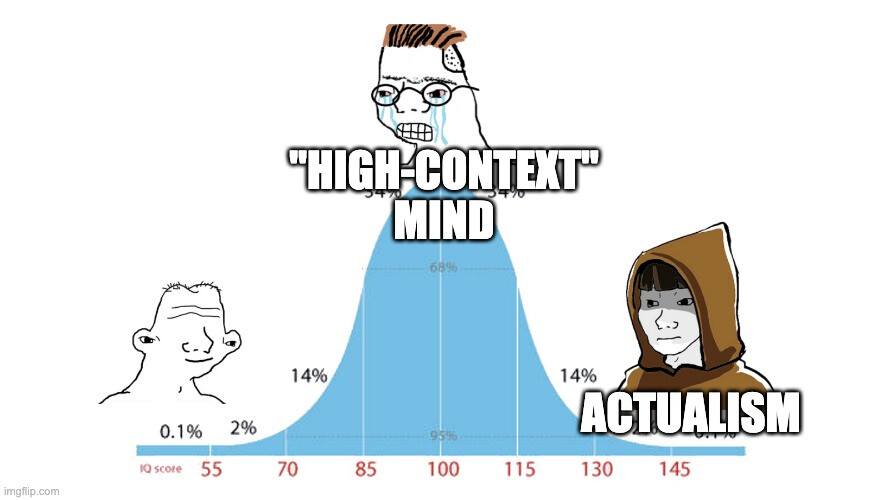
To put it in a format you may appreciate, from your perspective, I can guess that the situation looks to be the following:
In other words, you are far beyond what us mere neurotypicals can comprehend – you grasp everything we say, all-at-once, see all the flaws, and can hardly deign to even converse with us anymore because we can hardly even grasp one-fifth[10] of what you say.
In other words, you are endlessly and vastly overcomplicating everything, glossing over simple and basic points as if you already understand it and are way beyond them, while in fact the simplicity evidently continues to elude you. (As you haven’t replied to my last post, and based on your recent writings, it’s not even clear to me that you really do grasp that pleasant hedonic tone is not the metric by which felicity and innocuity is measured… but that would require another ~2,000 words to attempt to unpack.)
I will leave you off with some pertinent quotes (emphases added) – read them closely as there will be a Q&A at the end:
The Q&A is, for each of the following, answer whether these are descriptors or exemplars of something simple, unsophisticated, straightforward, etc., or rather of the observe:
“So, it turns out I can hold a lot of different things at the same time. Like a lot . The downside is that it is difficult to communicate at the same velocity and scope, especially with neurotypicals.” [source]
“a mind that holds a dozen things at once and ships them in a single breath” [source]
“This journal is itself a high-context object — allusive[11], over-compressed, forever linking off to its own elsewhere — which makes the glossary you’re standing in its decompressor.” [source]
“I write high-context: I know what I mean, and I’m quite content if it doesn’t fully carry to every reader . The fad’s daft and fair game, granted, the self having exhausted the zodiac and graduated to the DSM, ‘my’ rottenness “solved” the moment it’s issued a four-letter acronym. Grade-A psittacism (psittacus, n., parrot).” [source]
Regards,
Claudiu
“It is amazing how fast I can learn and adapt […]” ↩︎
“So, it turns out I can hold a lot of different things at the same time. Like a lot .” ↩︎
“The downside is that it is difficult to communicate at the same velocity and scope, especially with neurotypicals.” ↩︎
The faux self-deprecation of listing the only “downside” as being that normal people simply can’t grasp and comprehend what is being said hardly even needs to be pointed out. ↩︎
In your “me unpicking it” post you link to your February 16 post which quotes your February 15 post saying to Vineeto:
If you were to be privy to every text exchanged, words uttered, actions performed between myself and the WomanFromNov, you would have surely put ‘happy’ before ‘harmless’ in this particular context. I do understand what you are saying: happy & harmless are two sides of the same coin. Inseparable. […] [link]
However, neither me nor Vineeto replied to this one, and the other quote was more relevant in context, so I give the benefit of the doubt that you meant that one. ↩︎
Hi @1Syd, do you remember when you came back and made this post?
I was impressed you were able to openly and astutely describe many of the problems you have struggled with over the years. What happened to that guy? Do you really want to have to experience another two-weeks of near constant panic attacks before you can return to being sincere? Because you could just make the simple choice yourself instead of waiting for a woman to break your heart. (IF that will ever happen again, as you seem to have closed yourself off not only to the people here on the forums but also women. Currently you see them as potential arranged sexual partners that you can’t even be bothered to reach out to. This is a common but pathetic attempt to prevent yourself from being hurt while still satisfying your “needs.” Many men do it.)
Since childhood I’ve developed a defensive social identity shell, that pretty much caused me to ‘butt in’ with people from time to time. Along with it came a compensatory superiority complex…I didn’t want this to repeat again, so instead of retreating back to the shell (and use “actualism” to support it), I decided to thoroughly explore my social identity.
The shell is alive-and-well and you are back to that comfortable cocoon, this time with a new excuse to explain your resentment for us normies: autism and a high-context mind. You are repeating that which you didn’t want to repeat again, and it happened so fast.
You are doubling down on separation.
But I can still regress and lose interest and go back to the old ways. Plus, social identity exploration still felt ‘heavy’ and sudorific to me. So, I figured it is best to allow some PCEs now and use that as lodestone. This is what I’m focused on now, and I’d like to start journal here.
You shouldn’t have taken your foot off the gas with the social identity exploration. Your shell that you have been nurturing since childhood is not an easy thing to crack. I also doubt you have managed to allow any PCEs despite what your reports may say. You must be confusing self-induced mania with a PCE - hence your current statements of “I have zero interest in becoming actually free or having a PCE.”
But I’m glad to see that this place exists, with a better ambiance than Zulip, not to mention Vineeto’s helpful ongoing participation
It didn’t take long before that gladness was replaced by resentment. You’ve underestimated your social-identity/shell/coping mechanisms, have returned to pretense, and fell back to:
I was rarely interested in actually practicing the method on a consistent basis. Instead, the group became a “tribe” I could safely belong to and feel superior about, something I couldn’t in the “normal” groups out there
See? You are back to attempting to fitting into a “tribe” and are complaining about it when it didn’t work out for you. As well as feeling superior to the people here who you believe are incapable of understanding you.
In my experience, simply seeing an aspect of identity once has never been enough to fully discard it. It took persistent seeing and action which would sometimes last months or even years. I never knew if any aspect was gone until somewhere down the road I noticed I wasn’t repeating the same patterns in my life. There was no defining moment when a particular aspect ended. Realizations could be exciting but it didn’t mean that aspect of me was gone even though I wanted to believe that it was.
So if you say:
But I can still regress and lose interest and go back to the old ways.
Then perhaps you should be a little suspicious of your perceived success and not be so quick to race ahead. If things seem sudorific it is because it does take some persistent effort and also because what is noticed is not very agreeable or validating for the identity which you are. However the more you do it, and the more genuine success you enjoy, it does become less serious and more fun.
If you don’t want / can’t handle feedback, it’s my opinion that a private journal would be more effective. This way you won’t be limited by how you’re going to project and curate yourself to the public.
There’s also no risk of publishing anything half-baked or misleading that other people might read and emulate (IE. What if someone were to emulate your pretense for not wanting to become actually free?) And no risk of publicly embarrassing yourself in front of friends and colleagues which you may later come to regret.
Most importantly, in a private journal you can enjoy being candid with yourself for your own sake.
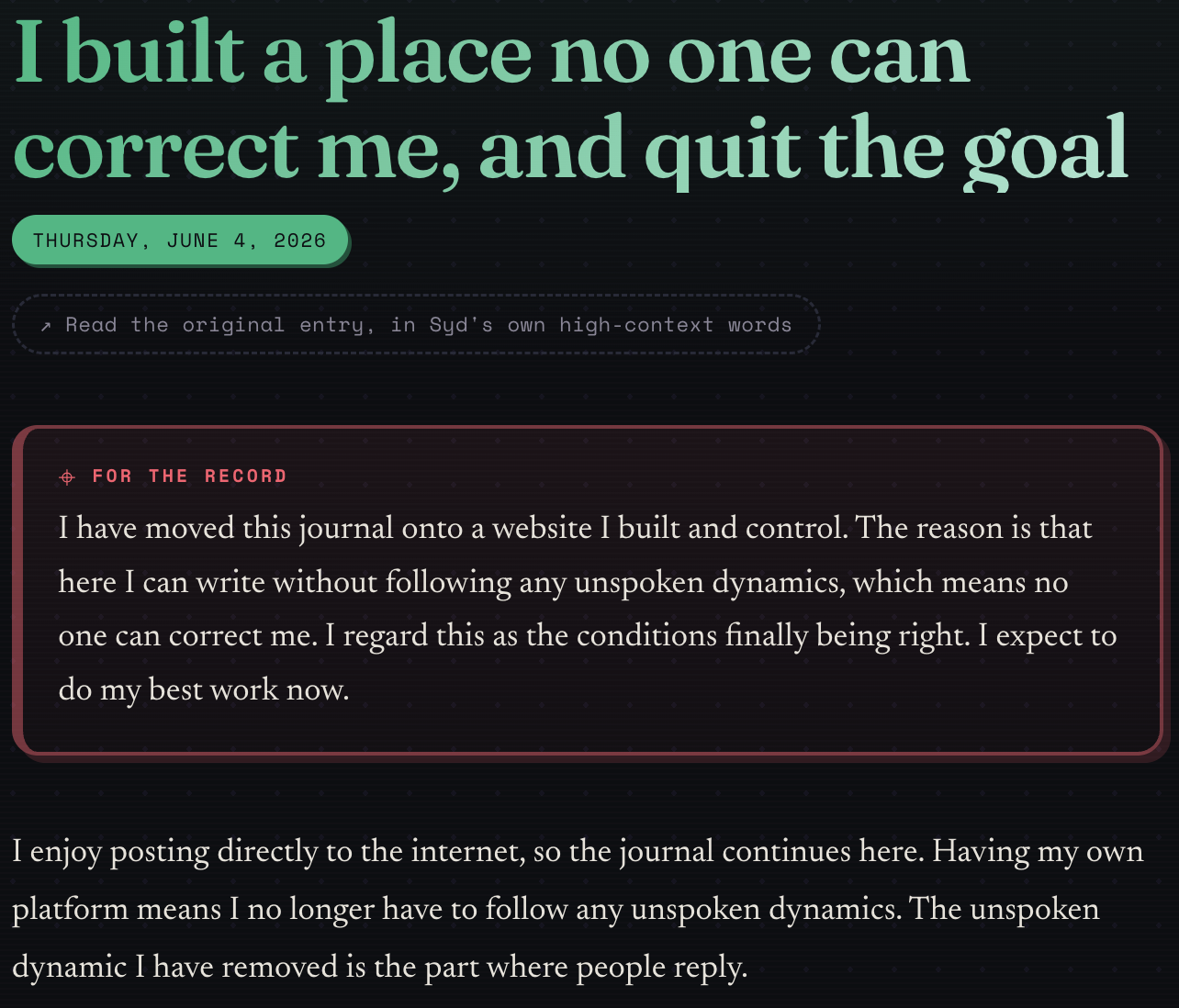
Having my own publishing platform means I can freely be straightforward, without needing to follow any unspoken dynamics
You do not need a publishing platform to be straightforward. You can just be straightforward in all instances. Such a statement is very telling that you have wandered off the path of being sincere and are back to trying to fit in with a “tribe” that only exists in your imagination. You have lowered the standard necessary for success and begun blaming others. Apparently, it is very common for identities to try to bring actualism down to their level instead of the other way around.
Have you not yet considered that these “unspoken dynamics” that you resent here on the forum might have something to do with your need to be validated? It should be obvious that this “need to follow any unspoken dynamics” is one of your own feelings, and not a rule others are imposing on you. It is entirely self-generated.
It’s so clear that actualism isn’t about fitting into a social dynamic that I wonder what your eyeballs were looking at when they read the website. However you are not the first to bemoan dynamics while offering no explanation. But usually people just quietly leave instead of inviting the party to go somewhere else.
You must be kidding yourself with this zero interest idea, although it would explain a lot. This is not unlike the droves of spiritualists who say things like, “I have no interest in becoming enlightened” in hopes that they’ll become enlightened.
Why lie to yourself? Or why associate with actualism (or simple actualism) at all? Why not make up your own method instead of borrowing so many misunderstood concepts from the thing you have no interest in becoming?
Or did I misunderstand you? Perhaps you expect me to read in-between the lines and understand that you are no longer pushing yourself.
I find it amusing that I don’t feel compelled anymore to reach out for sexual release. I have little interest in messaging my arranged sexual partner, unless she messages me out of the blue. No compulsion, because this moment is already fulfilling. Where else could I be?
Perhaps anywhere other than writing actualist fan fiction to the internet. Maybe spending some time with a woman you genuinely care about. The last one seemed to do you some good.
You clearly feel misunderstood but such is the life of an identity who can only be “seen” via validation. I look forward to when you sober up and cease attempting to create an invincible identity. Having peace on earth on your agenda would no doubt be more effective than waiting on the next go-round of personal suffering to move the needle.
Holy moly! I went through the diagnoses today, @Vineeto, four months of them by now. Quite a collection. A coffee shop became “Cloud Nine”. A good morning became “an altered state of profound detachment”. A bit of writing became “a hoax”, “deliberate misdirection”, “action with deception aforethought”. edzd co-signed with “self-induced mania”, big talk from a man who reviews everyone else’s practice, posts next to none of his own, and spends most of his time here telling the rest of us who to befriend and who to date.
The rule underneath is airtight, I’ll give you that. Enjoy being alive, it’s mania. Write it up well, and it’s “an obvious fantasy story, lol”. There’s no version of me it will accept as fine. What goes down well here depends on who’s talking, not what they’re saying: turn up announcing an out-from-control virtual freedom and you’re applauded, right until it falls apart; make a sound point and I get “eye-washing” while Claudiu gets “a brilliant exposition” for saying it back (I’ve since corrected the high-context footnote that got the history wrong). That isn’t a diagnosis, it’s a verdict you reached first and went looking for evidence after, which is fine by me, because it stopped being about me a while ago and runs along happily without me in it.
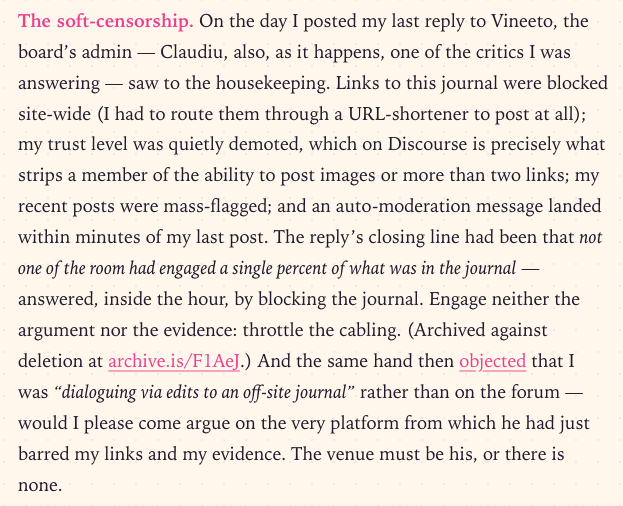
For the record, two things in here are just wrong on the page. You had ‘I don’t force it’ quoted right in front of you and still made it ‘he can’t manage without forcing, so nothing to discuss’ (forcing would be making myself happy on command, and I don’t; what’s left is sincere awareness and a sincere intent rooted in the PCEs, neither forcing nor suppressing. And when I dropped Richard’s framework in February and the practice actually moved (as my journal documents), you filed it under “an aeroplane that doesn’t get off the ground”. A verdict for the stall and a verdict for the take-off. Thorough. And for all the diagnosing, not one of you has engaged a single percent of what’s actually in the journal, which tells you more about the room than about me.
Anyway. Diagnose this one too; you will anyway. The cheeky revel that set you off is written up on the site if you want fresh material. Knock yourself out.
Syd
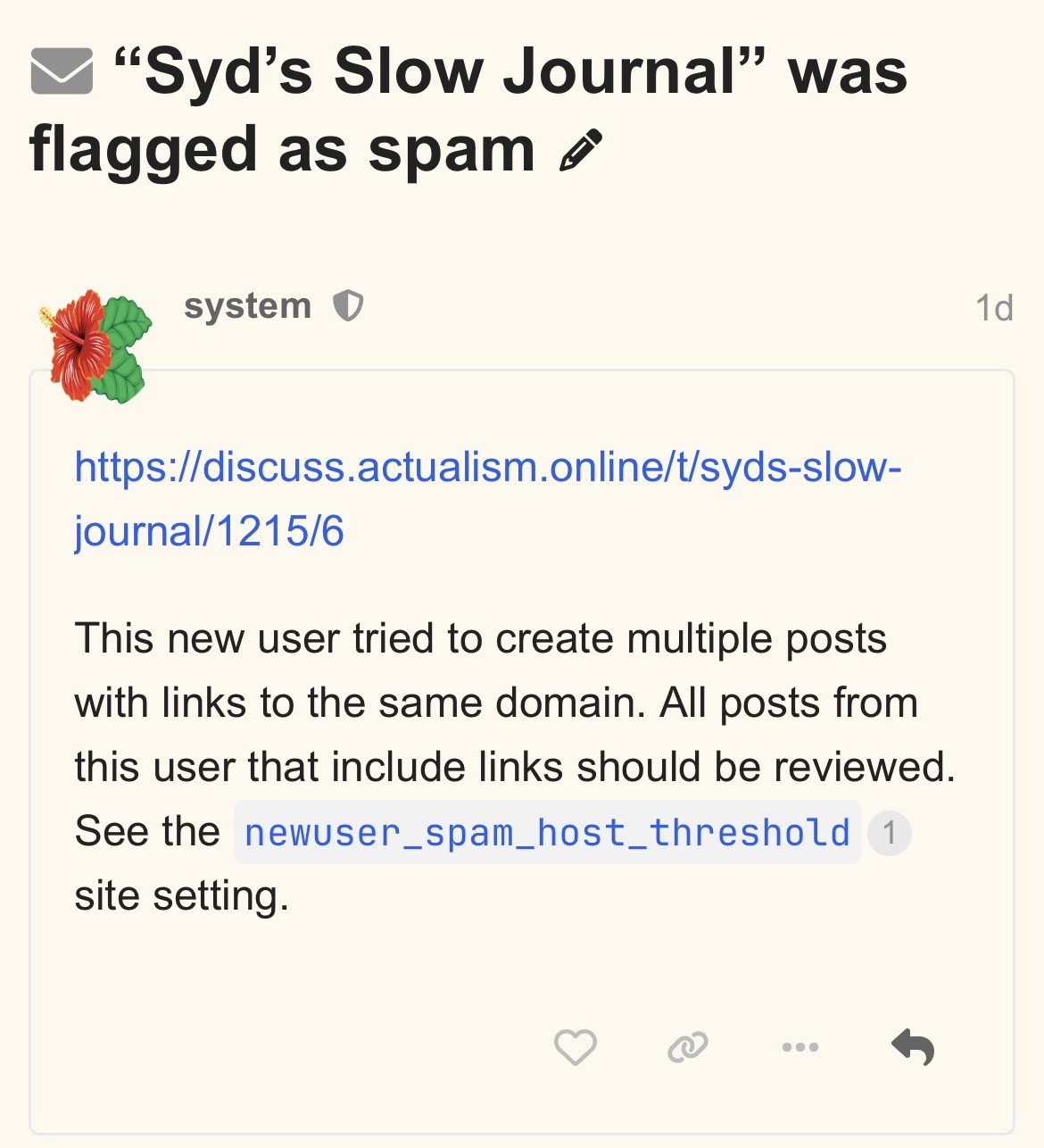
PS: Why are links to my journal blocked on this Discourse? I’m also blocked from posting images for some reason. And there’s excessive flagging of my recent posts. Suspicious activity. Anyway, if anybody wants to follow future posts, just directly visit my journal in the future.
Well I’ll grant that your ‘nurture’ post was pretty accurate in some ways w/ regards to how you tick… notably:
Indeed this “specialness/superiority” complex is powerfully alive and well, evident in every phrase you write.
It’s quite remarkable watching you flip back and forth among these… from posting a journal here, to not responding to earnest engagement with you, to coining a new term for why the “neurotypical” can’t understand you, to describing how you can’t be bothered to explain any of it anymore anyway, to continuously working on your public journal (which obviously is meant to be read by others else why is it public?), to not engaging with further responses here, to then bewailing how nobody is even engaging with you in the first place.
All the while you’ve made yourself out to be especially singled-out, as because it is Syd posting, you are wrong – again missing the point after I belabored to explain it to you (which explanation, btw, clearly has not landed, as your “high-context footnote” still has the history wrong… which combined with missing the same point yet again doesn’t speak too highly of your mental prowess), and in total ignoration of the full progression from when you first came onto the forum, and the responses to you then (careful, thoughtful, worked out, in-detail), followed by gradual realization from all parties that none of it was doing any good, which is why you are getting the feedback you are getting now and not because you are ‘Syd’ (i.e. if anyone wrote what you wrote, the responses would be the same).
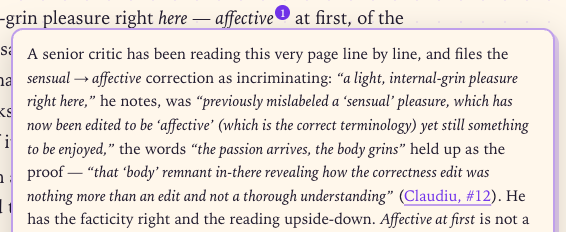
It’s been a particular watching-a-train-in-slow-motion-derailing experience seeing how you went from describing how you greatly enjoy lustful feelings, to getting the point (again after 10+ years) that lustful feelings intrinsically take away from what is called “feeling good” in the actualism lingo, to backtracking to how lustful feelings don’t take away from feeling good, and then to how they don’t take much away from feeling good, all the way back to… eh… enjoying those lustful feelings again, albeit now couched as “cheeky revel”… described as “a light, internal-grin pleasure right here”, previously mislabeled a “sensual” pleasure, which has now been edited to be “affective” (which is the correct terminology) yet still something to be enjoyed (“the passion arrives, the body grins” – that “body” remnant in-there revealing how the correctness edit was nothing more than an edit and not a thorough understanding), something to be “savour[ed]” and “revel[ed]” in, the pleasant-hedonic-tone endorsement of which is now described to lead to a “wider sensuous field”… all of which combines to really give no impression other than that you are yet again endorsing and revelling in ‘good’ feelings with their pleasant/positive hedonic tone, and mistaking this for the felicitous and innocuous enjoyment and appreciation of being alive.
Be that as it may… usually when someone touts ones’ own superiority it’s cause something is really lacking underneath, eh? Else why all the hullabaloo. Indeed if none of us get you at all, and are far behind you in your astounding turn-around success of a few months, and you have no need for any of us, and you’re happy and harmless and enjoying and appreciating being alive… why continue to engage here? Why these parting shots, after which you come back anyway, after which yet more parting shots? Every word you write is revealing, and one can only wonder if it one day will be revealing to you as well.
The ultimate proof, of course, would be for you to have PCEs, which you then describe in a way that everyone else who has had PCEs and actually free people can clearly recognize (which is universally the case when people who’ve had genuine PCEs) and from there to become actually free… but as you expressed explicit lack of interest in getting to that direction then I won’t be holding my breath. (Somewhat likely of course is that you are pursuing these, but you think you have to be not pursuing them for it to work… a strategem evidenced elsewhere in your self-reporting, which of course is anything other than naive and sincere… but as you write the words it is certainly simpler to take them at face value.)
Ok one more attempt since I think I found a tree-trunk rather than more fractal.
Compare & contrast:
vs.:
According to Syd, Richard’s advise is suppression and hence to be avoided (“you only hang a no suppression here sign on a room that is, in fact, full of it”). One does not wonder whose advice an aspiring actualist ought to take.
Syd further writes:
Despite his protestations of “never as a first-hand account”, Syd clearly did not read or has glossed over or forgotten the personal experience report I sent to him on Feb 26… viz.:
Syd also has clearly never had this experience of feeling so good – so happy and harmless, so excellent – that one gazes upon women that one recognizes one would otherwise be sexualizing, and is relieved at the total lack of that and the utter freedom at not having to deal with lust via any contortions this way and that, but rather being able to freely enjoy its palpable absence and the felicity and innocuity that continues unabated in its stead.
(If he did, he would not write the way he did above.)
Now what Syd is wanting an experiential report of is what to do if lust already did arise and its too late for it to not have arisen. Obviously the advice to not have it arise in the first place does not apply once it has already arisen, but is something to work towards as a general trend, and one wonders at the mental capacity and simple ability for plain logic of someone who has conflated the two.
Now, the experiential report of that is nothing other than what Richard already already wrote as working experientially, namely, declining to continue going down that path… this means not attempting to stuff away the lust or pretend it didn’t happen, but it also means not continuing to express the lust, which is not only actions (continued gazing, lingering, approaching if it gets there etc) but also thoughts, feelings, passions (enjoying the lust, reveling in it, ‘riding’ it on to something else… all of these are forms of expression).
It is more about keeping your hands in your pockets and letting it fizzle out from lack of energy… which it does, readily, if you don’t pursue it! Then one is once more back to felicity and innocuity.
Note well, experientially it’s not about taking that very lust and ‘riding’ it somewhere or ‘channeling’ it… it’s about not going there. And yes, you can do it before the passion fires. Once in the full midst of it it’s much harder to get off the ride, so you can catch yourself a little earlier, maybe when it’s just a flutter… and then you can catch yourself before that, when it was just a glance… and eventually via habituation you just stop going there entirely and it stops being a thing, and this particular passion is not firing in this particular way.
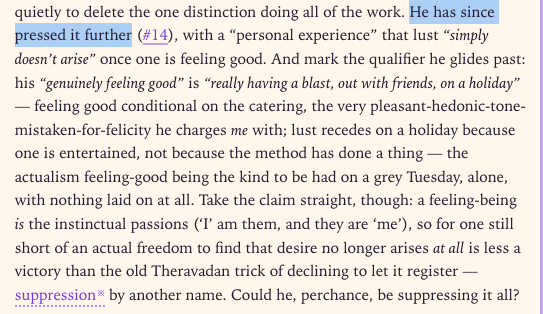
This is night-and-day from reveling in the lust (whether cheekily or not), enjoying and thus endorsing it (yes, to be enjoying a passion is to be endorsing it), which leads to a state of affairs where it continuously fires but the energy has somehow been transformed. Syd is conflating the advice to channel the affective energy to felicity and innocuity, as for somehow taking the ‘good’ and ‘bad’ feelings themselves and channeling them… this is not the case, it’s that by not going down those two paths, you then go down a third path. It is all affective energy at the root (it’s all ‘me’) of course, but you don’t get there by expressing down one path… and yes a heightened state of ‘good’ feelings being channeled is what hypomania and mania actually is, it can be hard to tell between them and feeling good (see: Alan, Milito), and many a person has conflated and many a person will continue to conflate them, but they are not the same, they are actually 180 degree opposite (the tell is that the mania-direction is rife with self-centeredness and self-indulgence, which is evident in the writings of the people going there).
So, the TL;DR is that Syd simply does nto believe that the actualism method is possible and capable of thoroughly addressing lust the way it does, and that people have succeeded in doing so… hence his apparent need to invent all sorts of other second-rate stuff instead (second-rate in that even on his highest gradation of ‘cheeky revel’ success, nevertheless “desire fires”… because he believes it has to).
Now let’s see how the fractal responds to such experiential reports…
Humm, well, while checking to re-read one of the footnotes, I see the fractal has morphed and responded[1], mightily… getting yet another historical fact wrong[2], and making a mountain out of a molehill of an automated moderation trigger that was promptly rectified[3], viz.:
The reflective nature of nearly all that is written is amazing – who is the one assuming intent[4] eh?
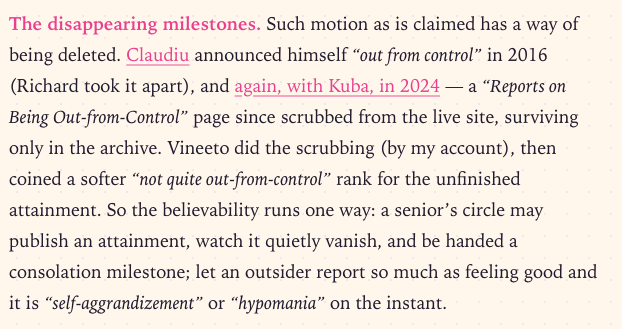
And, as I suspected back when it was first made, the request for personal experience was insincere — hastily dismissed[1:1], nothing penetrating the rapidly-evolving fractal which prevents any genuine insight…
Ok well I got to thinkin’, maybe Syd is right, and his high-context journal and mind are just incomprehensible to me… and since he’s indicated a lack of interest in decompressing it[1], it left me at a bit of a loss…
But then I figured, since he’s made such good use of AI tools[2], I could do the same! So I asked my own AI minions to make a… eh… ‘low-context’ version of the journal, for me and the rest of us neurotypicals.
I found it was way simpler and easier to understand for me, so I published it here to help advance the discourse: Syb’s Low-Context Journal.
Every page is mirrored with fully AI-generated, simplified, low-context text, converted straight from the high-context source. Who knew just how useful AI tools could be in figuring out this thing we call the human condition and how to become free from it! (/s[3])
/s is a sarcasm indicator used in text-based communication to show that a statement is not meant literally and should be read as sarcastic or ironic. [source]

 . It is clear that people have turned these labels into personas, it seems like an attempt to alleviate the weirdness and rottenness of the human condition by applying a neat and convenient psychiatric label to its inevitable manifestations. Besides just what is the ‘normal’ which the ‘neurodivergence’ is diverging from?
 .
.
 I do understand what you are saying: happy & harmless are two sides of the same coin. Inseparable. […] [