Hi Syd,
I noticed you updated the high-context page with the following footnote:
SYD: The specimen, for the curious. On the actualism forum I’d said happiness and harmlessness are inseparable and cannot be sequenced . A senior member corrected me — informing me I was “nevertheless establishing a sequence of happiness first, then harmlessness second” — and a second hailed the correction as a “brilliant exposition,” “patiently and expertly made clear.” Between them they had handed me back my own thesis wearing a rosette, both certain they were setting me straight on a point I’d just made myself, all because “before” was read on its wristwatch setting rather than the one I meant. (the correction; me unpicking it.)
Setting aside the grating tone of the AI-assisted writing, this is not the factually correct sequence of events – and the fact that you got the history wrong and that you further still don’t seem to understand what Vineeto and I were or why we were saying it, does not speak highly of the allegedly amazing alacrity[1], boundless bandwidth[2], and superior specialness[3][4], of this so-called[5] “high-context mind”.
The lynchpin is “all because “before” was read on its wristwatch setting rather than the one I meant”. By this you are presumably referring to your February 19 post[6] where you wrote:
However, the “correction” post was not even replying to this post of yours. It was replying to a different post, namely, this one (split among two posts):
The response I made was:
Note well that there is no possible way this post could have been in response to any post containing the word “before”, as there is no post by you whatsoever on that thread which contains that word “before”.
Now, I know well why I wrote what I wrote, and I’ll expand on it below. But first, a brief diversion into the rest of your footnote, which continues:
SYD: That’s the part about desire , not merely difficulty: when a misreading is that eager — when the small courtesy of asking what someone means never crosses a single mind — there is nothing left to fix by explaining harder, and I find I can’t be bothered to try.
This appears better directed at the person who wrote it than anyone else. You didn’t stop to ask either me or Vineeto why we wrote what we wrote. You merely assumed we forgot about what you said or never carefully read your post in the first place or that we didn’t really understand it. You then ehh rather eagerly took that assumption as definitive conclusion, used it to castigate me and Vineeto, and all this has now spawned yet another term (“high-context mind”), which apparently (from the current definition page) was created specifically to refer to the alleged inability of your correspondents to understand what you are writing (because your mind “holds a dozen things at once” and “ships them in a single breath”, “One sentence carrying ten”, where the correspondent can only “catch two” [i.e. one-fifth of what was said], due to the author’s “neurodivergen[ce]”… and you’ve “retired […] the belief” of having to “patch” misunderstandings because it is “dull work” [source]).
However, as none of these assumptions are warranted given the text of the replies, and it’s more that you misunderstood what we wrote and why we wrote it, it makes the allegedly advantageous acuity of this ”high-context mind” somewhat suspect, and rather deflates the entire premise of the term, and, apparently, of the (now “high-context”) journal itself[7].
The most egregious misunderstanding, which really ought to have prompted a follow-up question[8] rather than a conclusion that we know not of what we speak and we eagerly seek to misunderstand, is your conclusion that both Vineeto and I missed the fact that you yourself already wrote that happiness and harmlessness are "inseparable and cannot be sequenced". However, this is plainly false – the quoted response post above directly addresses that “even though you say that happiness and harmlessness are two different elements of the same thing,” and even literally quotes you saying they are “two different aspects of the same thing”.
Vineeto’s response as well contained a direct reference to what you said, even bolding the key terms and writing how pleased she is that you got it:
Your response to all this was:
This response is mind-boggling because both of us clearly read what you wrote and were directly addressing it.
Now, the reason I wrote the “correction” post I did (I can’t speak to Vineeto’s reasons, though I do presume they are quite similar), is because of the way you were talking about happiness and harmlessness and the relation between the two. You wrote, with regards to being angry at your father and this leading you to find harmlessness as a motivating factor, that:
Note the way you talk about it here: you write as if there is already an “existing motivating factor of happiness”, and then you find this “harmlessness” to be a factor on top of that.
This is not someone maliciously misreading a single word “before” and misinterpreting it – it’s literally how you actually presented it (and we can only go by what you write).
(Also, in the normal course of conversation, someone says something, the other responds to it, and if there’s a misunderstanding, then it’s an opportunity for the first to clarify – rather than walk away “[n]ot in a huff” [source] and give up.)
Further you wrote:
Again here you talk about a position of “having already established happiness as no. 1 priority”, and that without that… harmlessness seems like morality!
The phrase “having already” clearly denotes something already done. You write it very plainly here that only with happiness first/firstly established/already established, does it make sense for you to consider harmlessness – hence a type of “sequence”. Not necessarily chronological, but a certainly a priority ordering.
This is why I wrote the rest of my response as I did, pointing out that harmlessness can be the entry point into the self-reinforcing happy and harmless duo as well as happiness.
Your response may, yet again be, to protest, that you did write that happiness and harmlessness are inseparable, not able to be sequenced, etc., and that you know all that and you are not sequencing them. Yes, you did write that. Both Vineeto and I acknowledged that, each time repeatedly.
The overarching point is that actualism is not about stringing together the right sequence of words and then getting a cookie when you’re able to properly repeat the sequence. Actualism is about gaining the experiential insight into these matters, and having it genuinely change one’s way of being. The best way one can help someone do this is by reading the entirety of what you write, then making an assessment as to what is really going on, and then speaking in an attempt to address that.
In this case, based on the quotes above, the other stuff you said about happiness and harmlessness indicated a still-lingering promotion of happiness over the other.
If you had said, instead, for example that harmlessness doesn’t work (seems like moralizing) unless you’re happy, but also happiness doesn’t work unless you’re already harmless – this would have been a different matter. Note that even if you had perfectly said all that, it still wouldn’t mean you necessarily got it, and it would be a matter of seeing what else comes up too.
Now it’s entirely possible we were mistaken and though there was a prioritizing of happiness without harmlessness in the past, there isn’t one today – sure. That would be a topic of further conversation, not, eh… all this.
Now, in terms of a highly adept mind holding many things at once, compressing information density at high velocity – consider that all ~2,200 words that I wrote above, I essentially grasped all-in-a-moment from the first time I read that 93-word paragraph in your “me unpicking it” post[9] (with relevant further parts similarly readily apprehended when reading along the following posts).
Further, essentially every paragraph you write, often once per sentence and sometimes even multiple times per sentence, I come across some such a misapprehension, misconception, misunderstanding, a very clear and glaring going-awry, which is similarly grasped all-at-once. The impression given is one of fractal wrongness – where the gist of the post as a whole is to be going in the wrong direction, each individual component is also going in the wrong direction, and when unpacking one particular misdirected part, coming across even more misdirected other parts. To make matters worse, engaging with the fractal only causes it to spawn off even more fractally-misdirected offshoots, making the situation worse, not better.
Faced with such a morass, it’s then a matter of sitting and deciding which battle to pick, or even, whether to engage at all.
The point of this post in particular is to demonstrate that what you have embraced and called a “high-context mind”, is not conducive to the practice of actualism.
To put it in a format you may appreciate, from your perspective, I can guess that the situation looks to be the following:
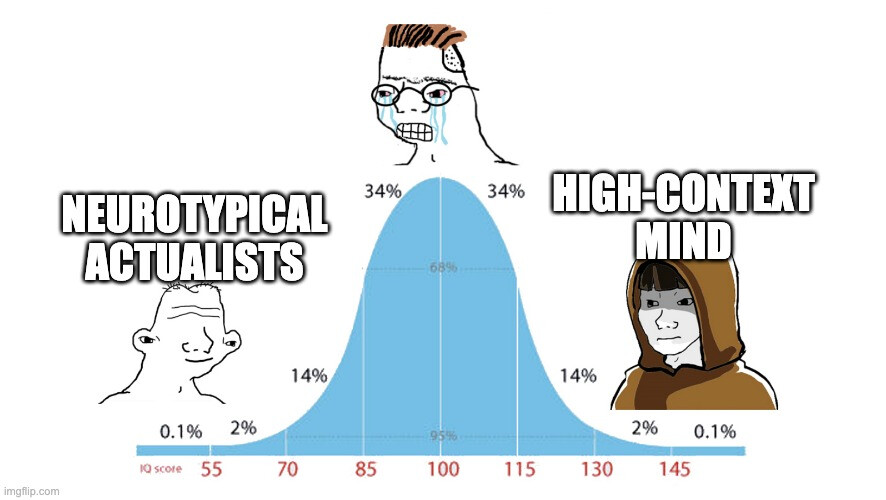
In other words, you are far beyond what us mere neurotypicals can comprehend – you grasp everything we say, all-at-once, see all the flaws, and can hardly deign to even converse with us anymore because we can hardly even grasp one-fifth[10] of what you say.
However, the situation is closer to this:
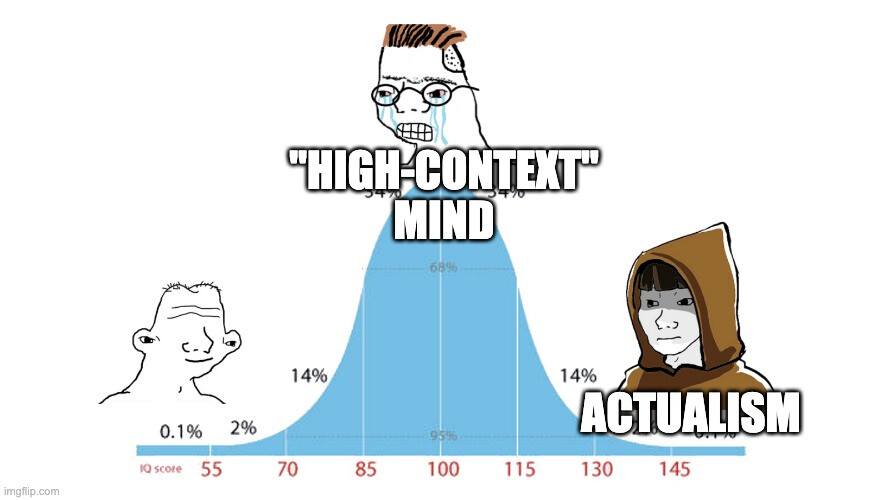
In other words, you are endlessly and vastly overcomplicating everything, glossing over simple and basic points as if you already understand it and are way beyond them, while in fact the simplicity evidently continues to elude you. (As you haven’t replied to my last post, and based on your recent writings, it’s not even clear to me that you really do grasp that pleasant hedonic tone is not the metric by which felicity and innocuity is measured… but that would require another ~2,000 words to attempt to unpack.)
I will leave you off with some pertinent quotes (emphases added) – read them closely as there will be a Q&A at the end:
The Q&A is, for each of the following, answer whether these are descriptors or exemplars of something simple, unsophisticated, straightforward, etc., or rather of the observe:
- “So, it turns out I can hold a lot of different things at the same time. Like a lot . The downside is that it is difficult to communicate at the same velocity and scope, especially with neurotypicals.” [source]
- “a mind that holds a dozen things at once and ships them in a single breath” [source]
- “This journal is itself a high-context object — allusive[11], over-compressed, forever linking off to its own elsewhere — which makes the glossary you’re standing in its decompressor.” [source]
- “I write high-context: I know what I mean, and I’m quite content if it doesn’t fully carry to every reader
 . The fad’s daft and fair game, granted, the self having exhausted the zodiac and graduated to the DSM, ‘my’ rottenness “solved” the moment it’s issued a four-letter acronym. Grade-A psittacism (psittacus, n., parrot).” [source]
Regards,
Claudiu
“It is amazing how fast I can learn and adapt […]” ↩︎
“So, it turns out I can hold a lot of different things at the same time. Like a lot .” ↩︎
“The downside is that it is difficult to communicate at the same velocity and scope, especially with neurotypicals.” ↩︎
The faux self-deprecation of listing the only “downside” as being that normal people simply can’t grasp and comprehend what is being said hardly even needs to be pointed out. ↩︎
(by you) ↩︎
In your “me unpicking it” post you link to your February 16 post which quotes your February 15 post saying to Vineeto:
If you were to be privy to every text exchanged, words uttered, actions performed between myself and the WomanFromNov, you would have surely put ‘happy’ before ‘harmless’ in this particular context.
 I do understand what you are saying: happy & harmless are two sides of the same coin. Inseparable. […] [link]
However, neither me nor Vineeto replied to this one, and the other quote was more relevant in context, so I give the benefit of the doubt that you meant that one. ↩︎
Long gone are the days of the following, it seems:
↩︎- ↩︎
“One sentence carrying ten; you catch two and quite reasonably assume that was the lot.” [link] ↩︎
allusive: characterized by or containing allusion; allusion: an implied or indirect reference ↩︎
