Which is to say, if it’s natural state is towards believing the ridiculous, then it hardly matters if it makes sense or not to be happy and harmless.
It of course makes sense, but it’s not a matter of talking oneself into it.
Just do it.
Which is to say, if it’s natural state is towards believing the ridiculous, then it hardly matters if it makes sense or not to be happy and harmless.
It of course makes sense, but it’s not a matter of talking oneself into it.
Just do it.
Fuck I’m lost
Haha, you had to be there! 
OK good I won’t strain too hard trying to make heads or tails of it then.
But it sounds like you came upon something worth going with. So good on you.
I could have another less convoluted go if you would like?
Please. For those on the outside looking in.
Ok. Perhaps starting at the conclusion is better than how it occurred to me;
The very fact that a ‘self’ can be/believe horrible things about itself/the body it’s in, makes a ‘self’ malicious.
It is functionally malicious.
It intends harm by itself. It is needlessly harmful. It’s natural state is to cause suffering/be suffering.
I would normally launch into a metaphor or simile, but nothing comes to mind. 
As far as why it’s like this, which is the primary objection I have always had, I have no clue.
Thank you for being concise. I see.
Now you also allude to depth psychology, which involves understanding unconscious psychological forces by interpreting various conscious and semi-conscious phenomena (dreams, patterns of speech or behavior, slips of tongue, idle doodlings, whatever). Were you able to discern the malicious nature of self (i.e., a basic and natavistic desire or intention to harm) through interpretation of conscious acts that reveal unconscious impulses?
Is it that the self is hurting itself because it wants to hurt itself? (Hence it’s malicious nature)
Or is it that the unconscious self is intentionally trying to hurt the conscious self?
I probably shouldn’t have mentioned that stuff, in that it wasn’t directly how I am realising this.
Ok, so as far as interpretation of conscience and semi-conscious phenomena;
I was expecting yesterday, before the psychedelic trip, that I would be enjoyably exploring something “deep”, a hidden fear, a long burried sadness. Something profound.
My intention was however to find out why I don’t have intimacy within myself, and it’s manifestation of rejection of myself and others.
This intention, it would seem, overrided my fluffy expectations and propelled me into the harshness of my own hatred, aggression, discontent, resentment.
Reflecting on this today, it is making sense that the experience of malice preceded the experience of sorrow. Not that it’s a hugely important point, or maybe it is, but I am getting the inkling why Peter’s approach worked.
Focusing of harmlessness before happiness removes the cause of sorrow.
That is, if I stop hitting myself with a hammer, I will have also automatically stopped feeling pain (eventually).
Ah, simile achieved; when one is a hammer, everything looks like a nail!
Because it’s evolutionarily advantageous to be malicious, including toward oneself
Keeping in mind that the instinctual suite was developed eons before more advanced thought
Oohh, interesting. You are actively hurting yourself, actively hating yourself, resenting yourself, etc., hence feeling the pain from that self harm. From those malicious acts. Naturally, if you stop harming yourself, you won’t be harmed by self-harm. Is that correct?
Yes, the very ‘thing’ I am as a self hurts itself and everything around it.
As to why? No idea. However, I was looking for an experience which would reveal greater intimacy.
What I am hugely encouraged by is of course the reports of others who have had success becoming harmless. I am happy for future generations to work out the “why it is so”.
Interestingly, as I write and contemplate this, I feel the nauseating swirl of ‘self’ protection.
So the choice is clearly there. Neither express or repress this, rather it’s now the actions both mental and physical which will cause change.
So, I could wrap my mind around the malicious nature that actively, consciously, voluntarily, intentionally harms oneself out of hatred and resentment towards oneself (just as one might do so to someone else you hate or resent), but you also suggest perhaps that a newborn engages in this kind of malicious and thus conscious, intentional, voluntary self-harm as well.
Is a baby that is hungry and thus in distress likewise maliciously (consciously, intentionally, voluntarily) self harming?
Yes, that was a theme in yesterday’s trip. Lobsters, and crusted tough fascades, sun damaged fibreglass fairgrounds, painted with someone’s gaudily coloured interpretation of “happiness”. The aggressive churning out of the superficial marks of success. More, more, more! No softness, just the endless husks of discarded seed pods.
I think part of the instinctual setup is that it doesn’t have to be conscious to operate
Malice:
the intention or desire to do evil; ill will.
One can have an unconscious desire operating, even as a newborn
The very mechanisms of ‘self’ are malicious.
Whilst I maintain it take time for to to be apparent in the child’s life, it is the very ‘self’ which is the malice.
It’s a spider’s fangs biting themselves. The snake eating itself. The intention to harm is it’s very ‘substance.’
But intention requires deliberate, knowing, and conscious activity.
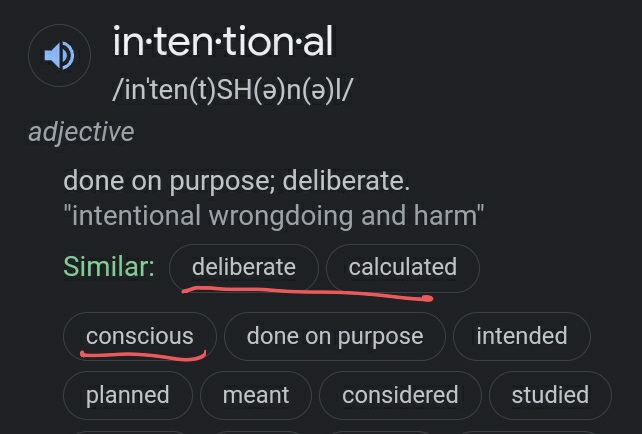
Well, ‘good’ and ‘evil’ are subjectively judged. But if one wants, then the intention to do evil to oneself if the nature of self. The suffering may well have had an evolutionary advantage.